Job recruiting SaaS
Job Hunt
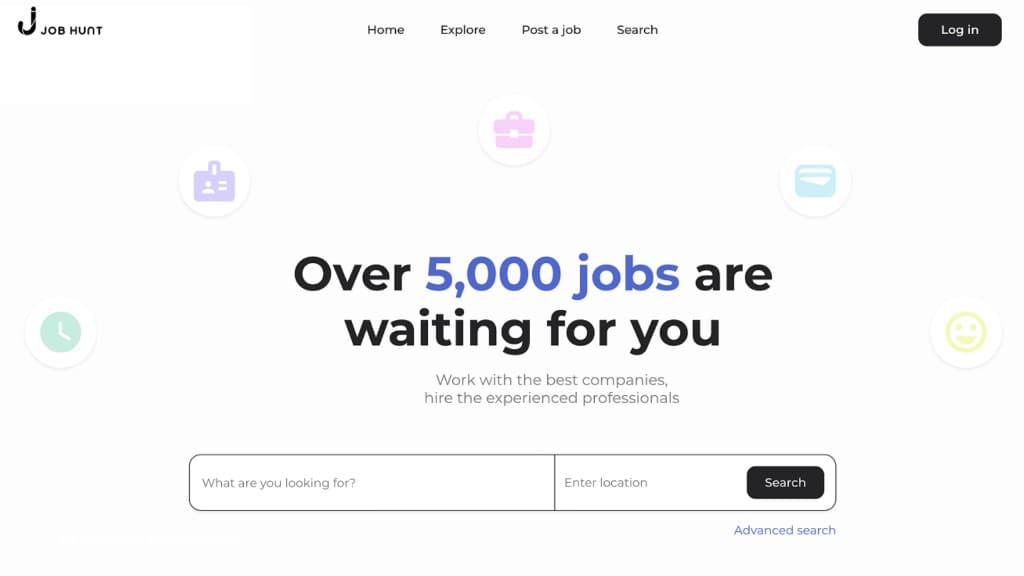
A two-sided hiring MVP where candidates search open roles by keyword and location, and employers post and manage their own listings.
The product
Story
A hiring product is judged on its first search. Job Hunt needed an MVP that proved the two-sided loop: candidates finding relevant roles quickly, employers publishing openings and reaching them.
The build stayed on that loop. Search by keyword and location with an advanced view behind it, a posting flow employers can run themselves, and AI in the matching step, on a platform built to stay secure as listings grow.
Scoped to one loop
A two-sided marketplace can absorb an unlimited amount of work, because both sides always want more. The scope held because it was defined as a single loop rather than a feature list: one path through the candidate side, one path through the employer side, and the point where they meet.
That is the method described in how to scope a first SaaS system in 14 days. Everything a hiring platform eventually needs was allowed to exist, on a list, outside the MVP.
Search first
Candidates search open roles by keyword and location, with an advanced search view behind the simple one. The simple search is the one that has to be right, because it is the first thing a candidate does and the moment they decide whether the product is worth returning to. The advanced view is there for the smaller group who want to narrow further.
Employers manage their own listings
The posting flow lets employers publish and manage their listings themselves. Self-service is the difference between a marketplace and a service business with a website. It also puts the information in the hands of the people who own it, which is the same reasoning behind when your SaaS needs a customer portal.
Two account types, not a permission matrix
Candidates and employers have separate accounts. Because the account type answers the question of what a user can do, permissions stay simple, and the two experiences can differ without a maze of toggles. Keeping roles boring is one of the choices that keeps a first build on schedule, as covered in SaaS MVP architecture.
AI inside the flow, not beside it
AI features are built into the hiring flow itself rather than bolted on as a separate tool. The model supports the matching step in the product people are already using, which is what makes an AI feature useful rather than a demo.
Client feedback
Fikre, founder of Job Hunt, described it as an outstanding experience building the MVP, citing exceptional technical expertise, delivery on time, clear communication and a proactive approach to every challenge. On the product itself, the feedback was that the AI features were integrated seamlessly into a secure, scalable platform, and that the final result exceeded expectations on performance, user experience and design.
This kind of build runs as a fixed-scope SaaS MVP sprint, with the model-backed parts shaped as AI product development.
Delivery
- Keyword and location search across open roles, plus an advanced search view
- Posting flow for employers to publish and manage their own listings
- Separate accounts for candidates and employers
- AI features built into the hiring flow
Client feedback
“An outstanding experience building the MVP for our job recruiting platform. Exceptional technical expertise, delivered on time, with clear communication throughout and a proactive approach to every challenge. AI features were integrated seamlessly into a secure, scalable platform, and the final product exceeded expectations on performance, user experience and design.”
Related services and guides
Service
Saas Mvp Development
Service
Ai Product Development
Guide
How to scope a first SaaS system in 14 days
Fix time and budget, then scope. One workflow, one system, a clear handover.
Guide
SaaS MVP architecture: what to build in version one
Monolith, auth, database and API boundaries for a first SaaS product.
Guide
When your SaaS needs a customer portal
One owned place for status, files and approvals instead of scattered email.